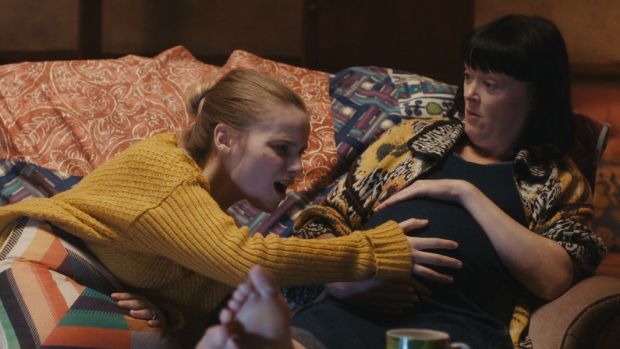
A Bump Along the Way (2019) review – intimate tale of an unplanned, later pregnancy driven by leading cast

Central performances are the driving force behind this feature film set in Derry, with Bronagh Gallagher and Lola Petticrew creating a believable mother-daughter relationship .

In this feature debut from writer Tess McGowan and director Shelly Love, Bronagh Gallagher and Lola Petticrew star as Pamela and Allegra respectively, the mother and daughter pair at the heart of this comedy-drama set in Derry. A twist on the archetypal mother-daughter pregnancy story, A Bump Along the Way sees the 44-year-old Pamela become pregnant after a one-night stand with a much younger man, much to the horror of her teenage daughter Allegra.

Gallagher’s portrayal of Pamela is the driving force of the film. Funny and heartbreaking in equal measure, Gallagher thrives in the role of the single mother trying to make ends meet and keep a positive attitude. She is given the opportunity to showcase her excellent comic timing; her scenes with best friend Sinead (Mary Moulds) are a particular delight, with the two bouncing off each other beautifully. However, Gallagher truly shows her class in the film’s more serious moments, showing the audience Pamela’s inner turmoil with a remarkably realistic subtlety.

Petticrew also thrives in the role of Allegra, the teenage daughter who struggles to fit in at school and whose demeanour juxtaposes that of her mother. McGowan’s script does a good job of depicting Allegra’s embarrassment at her mother’s pregnancy but Pettricrew brings the inner conflict of the character to life, as she struggles to decide how she feels about the impending birth of her sibling. Her uptight performance is a nice contrast to Gallagher’s bubbly and fun-loving Pamela in the early stages of the film but Allegra slowly becomes more supportive and sensitive to her mother’s situation.
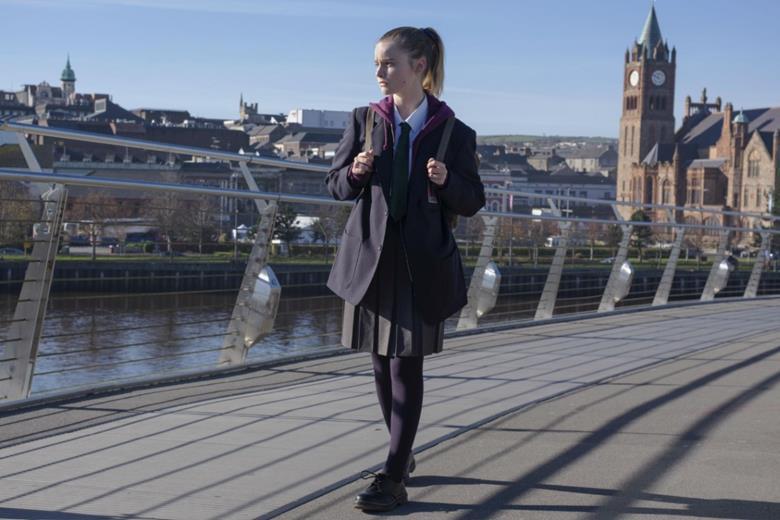
Lola Petticrew as Allegra

Many of the scenes take place within Pamela and Allegra’s family home, a decision that makes sense due to the character driven narrative. There are moments when A Bump Along the Way feels like it may have been better suited for the smaller screen due to this emphasis on interior shots and sequences. However, it is undeniable that these sequences help to create a sense of intimacy which is crucial for a viewer to feel connected to the characters involved. On the occasions when exterior shots are used, they truly take one’s breath away. The high angled long shots looking out over Derry’s stunning scenery feel inherently cinematic and offer a neat juxtaposition to the sense of intimacy evoked throughout the rest of the film.

This is a film that is undeniably proud of its setting, which is not just evident through its cinematography but through its dialogue. Words such as ‘gack’ and ‘leful’ are littered throughout the film, especially in the first act as A Bump Along the Way establishes its setting. This may feel alienating to an international audience but only adds to the film’s authenticity.

Despite feeling somewhat televisual at times, A Bump Along the Way works as an intimate piece of filmmaking and it delivers its message of support and love effectively. The film is undeniably heartfelt and the creative team should be applauded for showing a rare depiction in Irish cinema of a sexually active, middle-aged woman. It is the central performances that are the real triumph, with Gallagher and Petticrew showcasing their marvellous chemistry to evoke an authentic and believable mother-daughter relationship.

3 stars out of 5

Blinded by the Light (2019) review – a tribute to the power of music

Although lacking in focus, Gurinder Chadha’s latest adaptation says something charming about the transformative power of music.

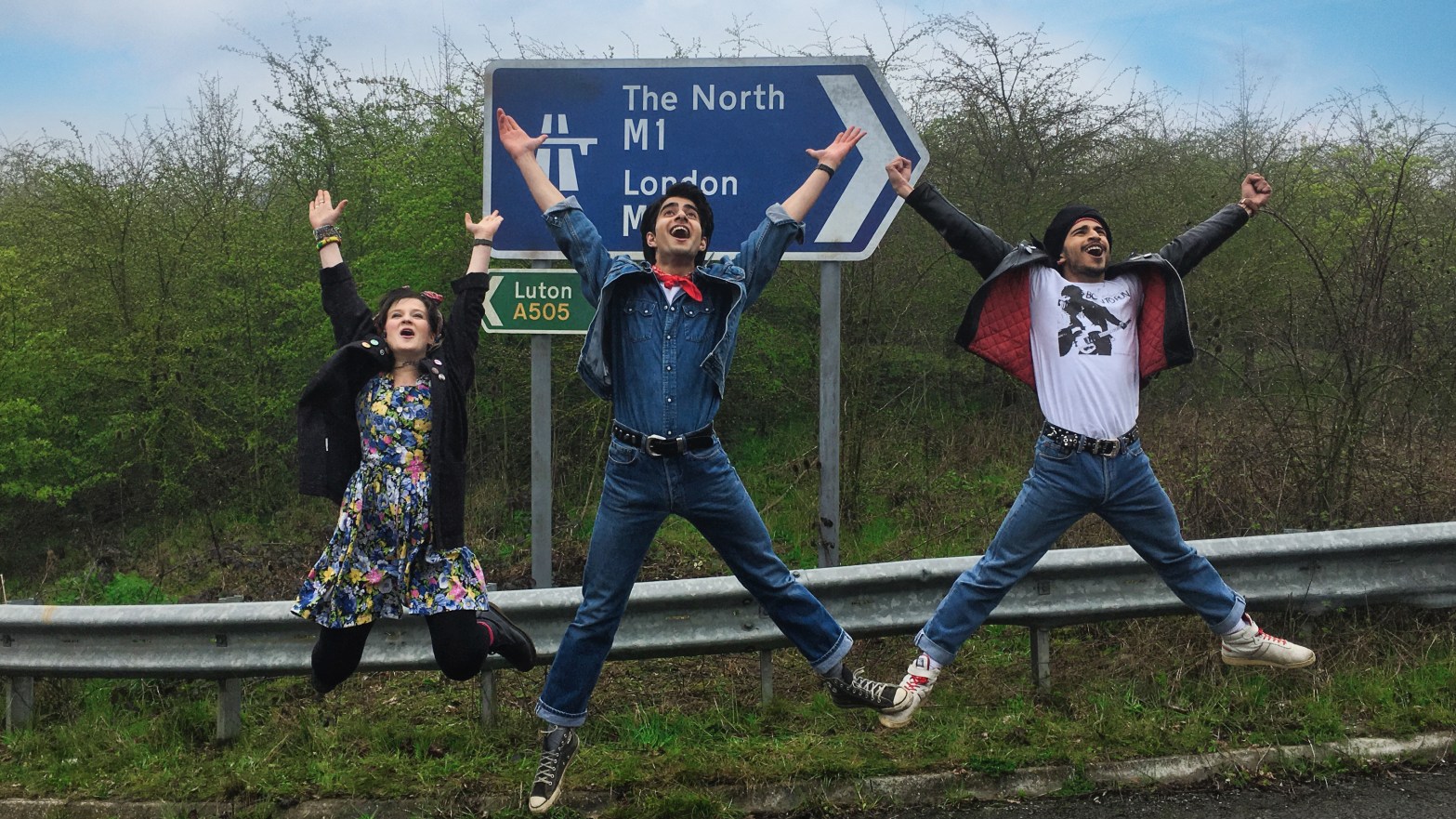
Gurinder Chadha, a director well-known for adapting from page to screen, is at the helm for this film adaptation of Sarfraz Manzoor’s 2008 memoir, Greetings from Bury Park. Telling the story of Javed (Viveik Kalra), Blinded by the Light focuses on the struggles and austerity faced by a British Pakistani teenager growing up in Margaret Thatcher’s Britain. Stuck in the town of Luton in 1987, Javed dreams of moving away and becoming a writer, which his domineering father, Malik (Kulvinder Ghir), wholly disapproves of. Feeling trapped and isolated, Javed’s life is transformed when he discovers the music of Bruce Springsteen.

A common theme throughout Chadha’s work is the struggle faced by immigrants in British society and this is certainly the case in Blinded by the Light. Although set in the 1980s, Chadha felt inspired to make this film due to her perception that there was an increasingly racist attitude rising towards immigrants in modern Britain. In an interview with CNN, Chadha is quoted as saying: ‘In Britain, Brexit was announced…and I was shocked, like many people, about how suddenly…all these xenophobes came from nowhere and I was really upset.’

Xenophobia and racism are present throughout the film, with one particularly harrowing sequence showing a young boy urinating through a Pakistani family’s letterbox. The boys’ actions are filmed through a glass window, with their animalistic behaviour being highlighted by Chadha’s framing of them like zoo animals.

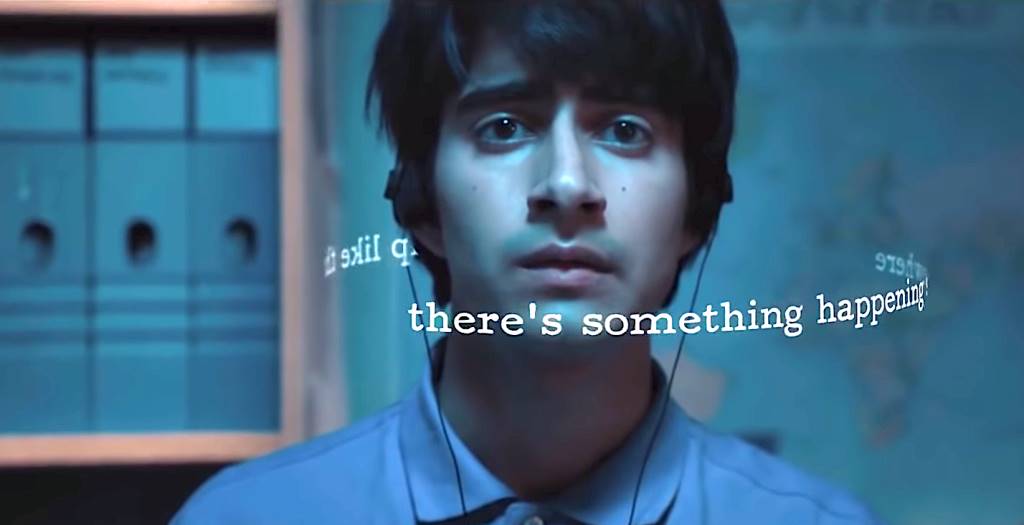
Javed (Viveik Kalra) discovers the music of Bruce Springsteen and his life is transformed.

As Javed struggles with his identity in a world that seemingly does not want to accept his Pakistani roots, his domestic life only serves to heighten that sense of isolation. Malik is written as a somewhat stereotypical immigrant father, who wants his family to retain their Pakistani traditions whilst Javed wishes to be independent. The conflict between father and son is at the heart of the film and, although clichéd at times, it feels authentic due to the performances of Ghir and Kalra respectively.

After a particularly fraught argument with his father, Javed listens to some Springsteen tapes that were given to him by his friend, Roops (Aaron Phagura) and he is almost instantaneously transformed. Springsteen’s lyrics literally appear as onscreen text, spinning around Javed’s head as he begins to make connections between Springsteen’s words and his own personal struggles.

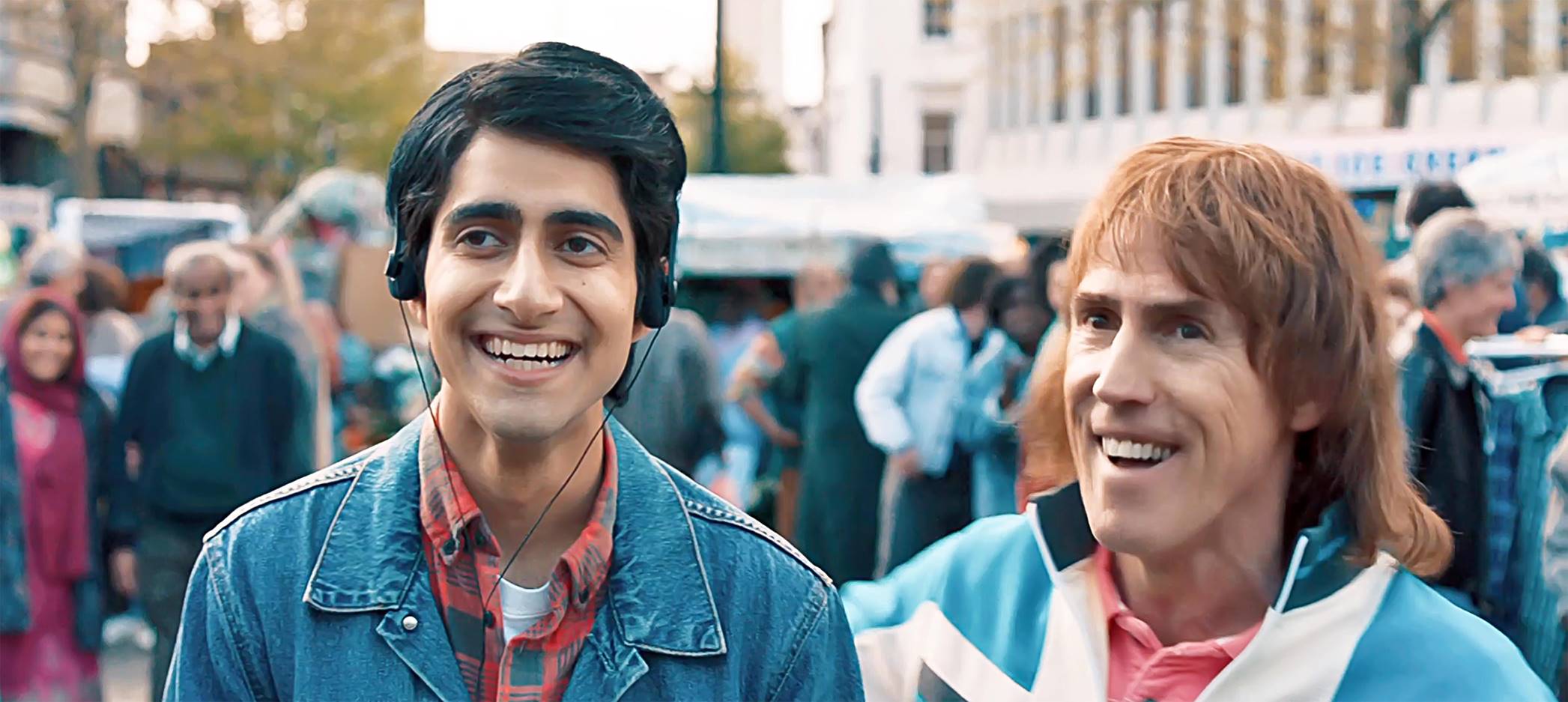
Viveik Kalra and Rob Brydon in the Thunder Road sequence.

From this point on, the film becomes a series of set-pieces, soundtracked by Springsteen’s back catalogue. It is worth noting that as Javed embraces Springsteen, Blinded by the Light gets increasingly cheesy and unashamedly so. Javed’s dialogue is often restricted to unironic recitals of Springsteen lyrics. There are moments in which the film teases becoming a musical, with the characters singing and dancing along to the sound of Springsteen. The most bizarre of these sequences is one in which Rob Brydon, doing his finest cockney accent whilst trying to avoid slipping back into his native Welsh, joins in with a street performance of Thunder Road. This reliance on Springsteen’s music to maximise audience response leaves the film feeling unfocused and unpolished, as narrative and dialogue are seemingly forgotten about in favour of Springsteen.

And yet, despite the uneven final product, there is something undeniably sweet and charming about Blinded by the Light. Whilst it is certainly a love letter to the music of Bruce Springsteen, it is more of an ode to the power of music itself. This is emphasised by the sequence in which Javed takes his sister, Shazia (Nikita Mehta) to a dance hall and she pronounces that this is the place in which she can be herself. Javed’s life is changed thanks to Springsteen’s music and this gives him the belief and confidence that he can achieve his goals, despite the austerity going on around him. His relationship with the music is inherently personal and yet it is also what unites him with those who are most important to him.

Blinded by the Light is undeniably cheesy and struggles in its middle section due to an uneven narrative. However, there is something genuinely sweet about the film’s message and its heartfelt belief in the transformative power of music. It has its flaws and often lacks focus but Blinded by the Light still works to some degree, thanks to Chadha’s faith in her cast’s ability to embrace the film’s gleeful cheesiness.

3 stars out of 5

The Lion King (2019) review – copycat remake visually stunning but pointless

Jon Favreau has created a film that is visually impressive but struggles to match the energy and charm of the 1994 original.

Beginning with Kenneth Branagh’s remake of Cinderella in 2015, Disney have been on a mission to rehash their beloved animated classics in the form of live action remakes. Although often receiving mixed responses from critics, these remakes have been commercially successful and it is therefore inevitable that many more are being produced. In 2019 alone, we’ve had remakes of Dumbo, Aladdin and now, a photorealistic take on The Lion King.

David Stephan, an animator on the original 1994 film, believes that these remakes are an indication of Disney selling its soul, with ‘the stockholder…deciding what movies get made’. He went on to tell the Huffington Post: ‘That’s disappointing as an artist, from a studio that was founded on originality and art.’

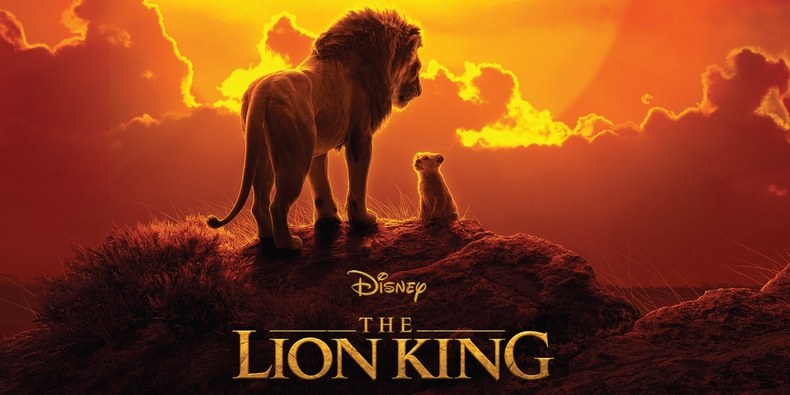
Promotional poster for Disney’s 2019 remake of The Lion King

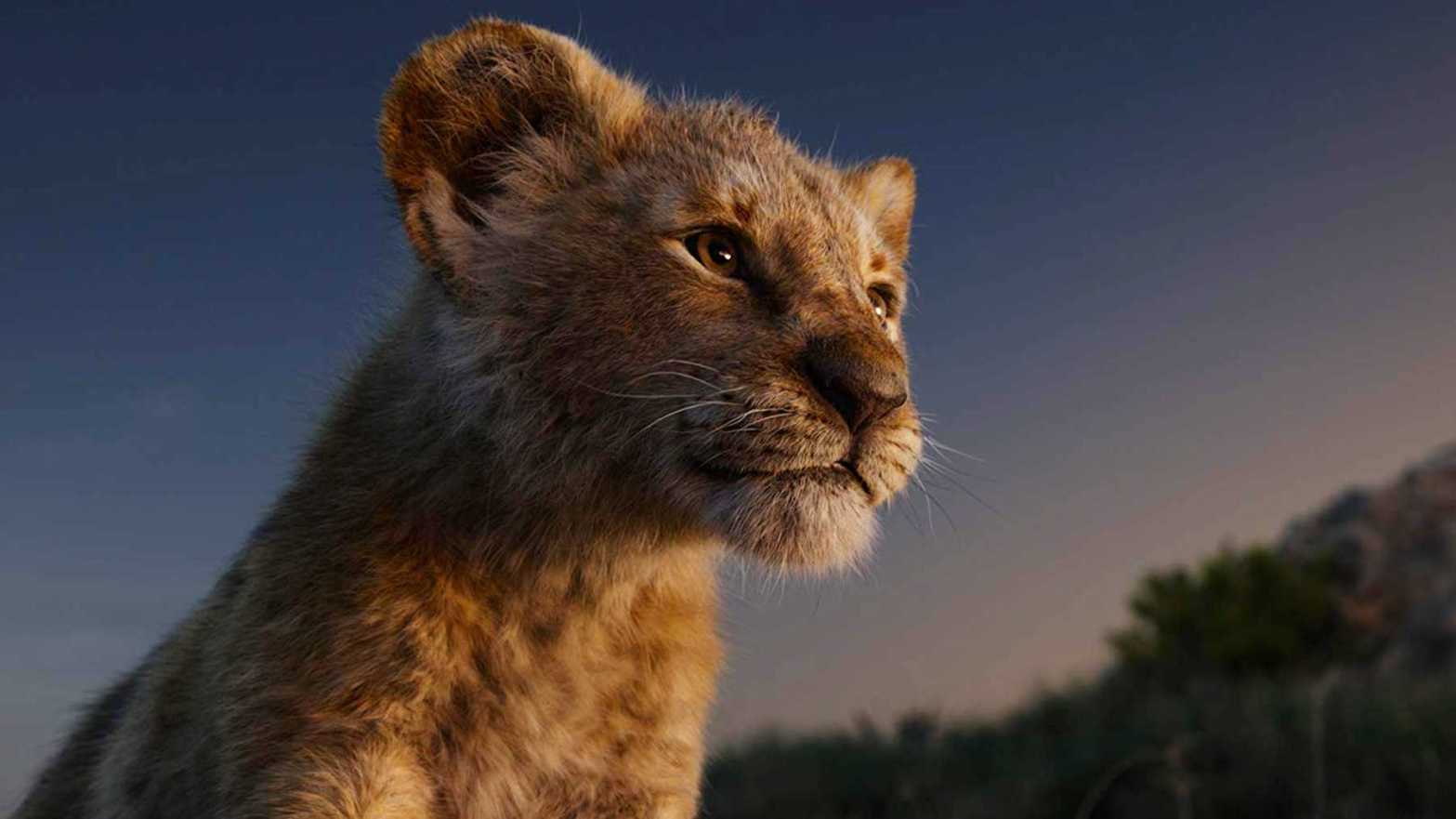
Whilst it is true that Disney’s recycling of their successful back catalogue cannot be praised for originality, that does not mean that Jon Favreau’s take on The Lion King is without artistic merit. In visual terms alone, this film is absolutely stunning. Despite this film being billed by many as a “live action” reimagining of The Lion King, there is only one real live action shot in the film: the opening establishing shot. Everything else in the film has been created by animators and CG artists and they have done a truly remarkable job.

The film opens in a familiar manner to the 1994 original, with a near shot-to-shot remake of the Circle of Life sequence. This opening sequence showcases photorealism and Favreau’s visual style at its best, with each and every creature being portrayed in a surreally lifelike manner. Some of the film’s finest shots appear in this sequence, with majestic sunsets filling the sky above the animals who are making their way across the beautiful Pride Lands. It is a visual triumph and when this is matched with the iconic, stirring musical number, its power cannot be downplayed. I felt an urge to begin a rapturous applause at the sequence’s close, perhaps down to nostalgia, but even more so because of the sequence’s dazzling authenticity. It is truly awe inspiring and it is worth viewing this film in a cinema for the opening sequence alone.

The only real shot in Jon Favreau’s The Lion King. This shot opens the film and was actually photographed in Africa. Every other shot in the film was created by animators and CG artists.

Whilst photorealism works wonders in the opening sequence, it begins to cause some problems as the film progresses. An awful lot of work has gone into making The Lion King look as authentic as possible, with the result being visuals that would not look out of place in a nature documentary. However, this emphasis on photorealism compromises much of the characterisation in the film. Mouth movements are an obvious issue, with photorealism not lending itself well to a film featuring talking and singing animals. As well as this, the lack of facial expressions is truly problematic. Whereas the original animation could give the animal characters profound human expressions, this is not possible in Favreau’s remake. The lack of emotion in the faces of the characters makes the film feel one-note and often monotonous.

This is not helped by the film’s pacing. Favreau’s film is incredibly faithful to the 1994 animation and each sequence in this remake seems to mimic the original. Despite this, Favreau still manages to add thirty minutes on to the running time from the original film. Given the lack of changes in both structure and narrative, the film’s near two hour running time feels unnecessary. In contrast to the energetic quality of the original animation, Favreau’s The Lion King struggles to maintain any sense of energy and drags itself along slowly in its middle section.

In terms of the voice cast, Donald Glover and Beyoncé Knowles-Carter show audiences their impressive singing capabilities in the roles of Simba and Nala. Chiwetel Ejiofor’s take on Scar is much less camp than that of Jeremy Irons but is just as menacing. It is Seth Rogen and Billy Eichner who steal the show in the roles of warthog Pumbaa and meerkat Timon, respectively, with their comedic exchanges feeling completely natural and unscripted.

Despite its flaws, Favreau has still created a film that is visually stunning. Unfortunately, despite the impressiveness of this photorealistic take on The Lion King, it struggles to match the energy and characterisation of the 1994 original. This leaves a viewer wondering what the point of it all is. If it struggles to match the energy and charm of the animation and does not do anything new with the narrative, the resulting film feels pointless.

3 stars out of 5
Design a site like this with WordPress.com
Get started